Trading the brief for brainwaves - how Cambridge NeuroWorks is powering Alastair Monty’s shift to neurotech
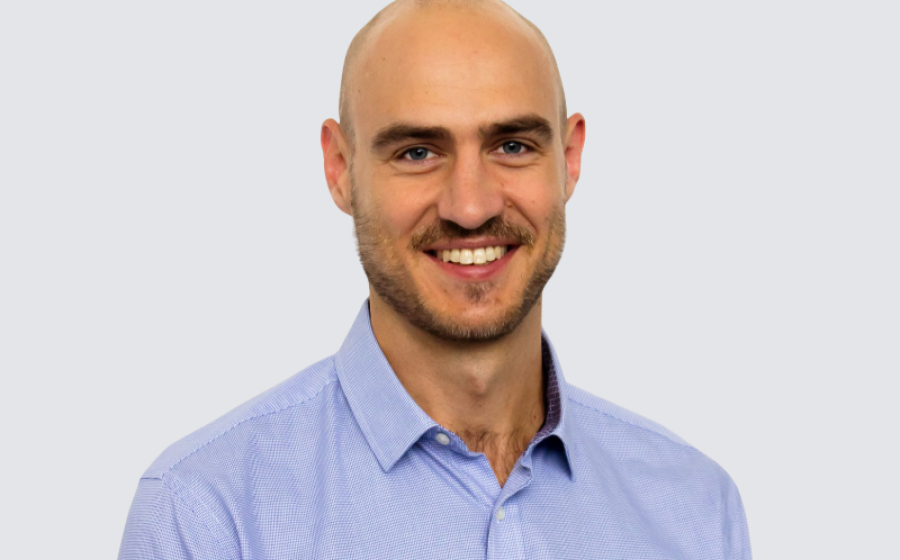
Transitioning from corporate law to neurotechnology isn't a conventional trajectory. But for Alastair Monty, founder and CEO of Mendea Technologies, stepping away from a stressful career in legal practice opened the door to exploring how technology can transform mental health.
Through the Cambridge NeuroWorks programme, Alastair, a Frontier Fellow based out of the Babraham Research Campus, has been able to draw on mentorship, expertise and wider neurotechnology community as he develops his approach.
Moving beyond corporate law
Interviewer: To start off, could you tell us a bit about your project and how Cambridge NeuroWorks has supported you?
Alastair Monty: I’m the founder and CEO of Mendea Technologies. My work focuses on developing non-invasive focused ultrasound delivered via a wearable headset to treat mental health conditions. By focusing sound waves at specific target areas deep within the brain, the technology modulates neural activity at those exact focal points to help treat brain disorders.
I’m starting with obsessive-compulsive disorder (OCD) as the first condition I intend to treat. As part of the Cambridge NeuroWorks Frontier Fellowship, I’ve had the unique opportunity to bridge the gap between commercial development and rigorous neuroscience, giving us the space and clinical network needed to validate our core assumptions and refine our technical direction early on.
Interviewer: That’s a significant career pivot. How did your personal journey lead you to focus on the brain?
Alastair Monty: Before founding Mendea Technologies, I was working as a corporate lawyer, a career I found to be highly rewarding, but equally stressful. During that time, I turned to meditation to reduce stress and manage my own mental well-being. Experiencing first-hand how intentional mental practices could alter one's state of mind, this sparked a deep fascination in me with how the brain functions, which ultimately turned into a passion to get the brain to work better overall.
Corporate law teaches you to evaluate risk, interrogate evidence, and structure complex information, skills that are surprisingly applicable when navigating the regulated, interdisciplinary world of neurotechnology. However, shifting to tech innovation required an updated mindset. Cambridge NeuroWorks gave me the freedom to embrace a process of testing, learning, and iteration.
Bridging targeted neurotechnology and clinical rigour
Interviewer: Non-invasive focused ultrasound is a novel approach for conditions like OCD. How does your wearable headset differentiate itself from existing solutions?
Alastair Monty: Currently, targeting specific, deep-brain circuits often requires invasive surgical procedures or bulky, hospital-bound equipment. On the other end of the spectrum, consumer wellness gadgets often lack precise, evidence-based neuroscientific underpinnings. Our device uses focused ultrasound waves built into a headset, allowing us to non-invasively reach specific targets within the brain to change brain activity precisely where it's needed, offering a potent, targeted intervention for severe OCD without invasive surgery.
Interviewer: How critical was the Cambridge NeuroWorks ecosystem in helping you refine that vision?
Alastair Monty: It has been essential. The fellowship gives you direct access to world-class researchers, clinicians, and industry leaders. It allows you to ask the hard questions early: Is this focused ultrasound approach technically sound? Is it clinically relevant for OCD patients? Will clinicians and patients adopt a headset of the kind I envisage? Having those conversations early saves years of misdirected development.
Shift towards translational impact
Interviewer: What drew you to the Cambridge NeuroWorks Frontier Fellowship in the first place?
Alastair Monty: I was drawn to the programme's explicit focus on impact through translation and high-risk, high-reward ideas. Traditional funding avenues often favour safe, incremental advances. Cambridge NeuroWorks, backed by ARIA, is built around the belief that true breakthroughs require step-changes. It creates a "safety net" where you are encouraged to push boundaries, gather data from targeted interventions, and adapt quickly.
Interviewer: How has being part of a community of fellows impacted your journey?
Alastair Monty: Building a neurotech venture can be isolating in the way that startup founding often is, but being surrounded by other fellows, whether they are developing brain imaging tools, wearable diagnostics, or AI models, creates a unique environment. We share the same fundamental challenge; taking complex science out of the lab and making it useful in the real world. That shared mission and cross-disciplinary exchange is easily one of the most valuable aspects of the programme. Rather than working in isolation, it feels like building a lighthouse together to help guide new therapies out of the lab and into the real world.