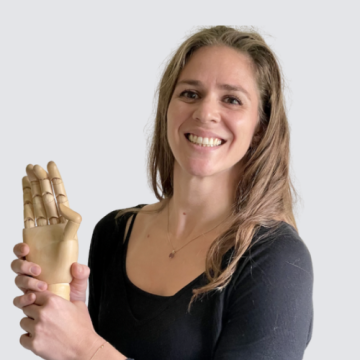

Liam was inspired into neurotechnology research by his fascination with the physics behind how it all works. His previous research as a PhD student and Research Fellow at University College London focused on developing methods to study the infant brain. This got him interested in times of life when the brain undergoes substantial changes in structure and how it works, and he now wants to apply his skills to support those with dementia.
Liam explored an ambitious idea: to develop a wearable brain imaging method capable of measuring key dementia biomarkers in point-of-care settings. Currently, there is no quantitative, portable, and easy-to-implement method to diagnose and monitor the progression of Alzheimer’s disease. Using principles of biomedical optics, Liam aims to change that - and is asking what if physics and engineering can be pushed even further to transform dementia care?
“I’m motivated to push physics and engineering principles to their absolute limit to improve quality of care for patients, which is highly aligned to the ethos of Cambridge NeuroWorks. I want to explore ambitious ideas that can have a huge positive impact for society but which are more speculative than what’s typically funded in the current academic landscape. I want to try, I want to fail, I want to learn from how I fail, and I want my work to benefit society.”
| Highlights | Context | More info |
|---|---|---|
| Publications | Have a look at Liam's research - Using innovative brain imaging technologies Liam uncovers how the brain changes across the lifespan. | Read here |
| Research Stories: Remarkable people, groundbreaking work, global impact. | In this research spotlight from Hughes Hall, Cambridge, Liam explains how innovative wearable brain imaging technologies are helping researchers better understand brain development, ageing, and dementia, with the goal of improving diagnosis and patient care. | Read here |
| Smooth Brain Society | Liam was a guest on the YouTube channel, Smooth Brain Society, where he spoke about the future of brain imaging. | Watch here |
| How can light be used to expand the horizons of human neuroscience | Disruptive Thinkers | Liam discusses how wearable, light-based brain imaging technologies are enabling researchers to study brain activity beyond the MRI scanner. | Watch here |