The brain gain - inside the UK-wide project, run from Cambridge, is that belief that the UK can lead the world in treating neurological conditions
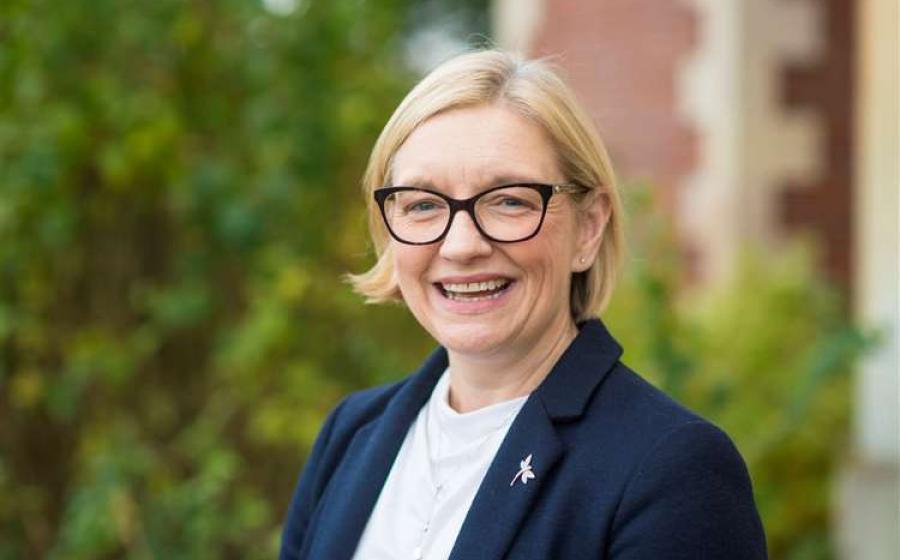
Dr Louise Jopling, Chief Scientific & Innovation Officer at Babraham Research Campus (BRC), and on the Joint Steering Committee of Cambridge NeuroWorks.
As the costs of care for individuals with dementia, depression, stroke, chronic pain and other neurological conditions spiral, a nine-partner consortium administered from Cambridge, but backing fellows and companies across the country, is trying to prove that the UK's fragmented neurotech scene can become a single, investable pipeline — and that founders no longer have to fail alone.
From a coordinating hub in Cambridge, a quiet bet is being placed on the future of British medicine — one being tested not in a single city, but in university labs, NHS trusts and biotech start-ups scattered the length of the country. At the heart of this challenge is the human brain, an organ that has resisted decades of conventional drug development but now demands our focus as an aging society pushes healthcare systems to their limits.
Cambridge NeuroWorks is a fellowship programme and consortium, powered by the government’s Advanced Research and Invention Agency (ARIA), built to back researchers and entrepreneurs working on brain health — from dementia and depression to chronic pain and the wider category clinicians increasingly call “brain health”, wherever in the UK they happen to be based. The nine partner organisations that administer the programme are themselves rooted in Cambridge: it is led by Cambridge University Health Partners (CUHP), which holds the grant and acts as ARIA’s activation partner, alongside the University of Cambridge and three of its constituent centres — the Maxwell Centre, the Milner Therapeutics Institute and Cambridge Neuroscience, as well as Cambridgeshire and Peterborough NHS Foundation Trust, Cambridge Network, the life-sciences venture-builder Vellos, and the Babraham Research Campus. But that is where the geography ends: the fellows, founders and technologies the programme supports are drawn from, and operate across the whole of the UK. Its premise is simple to state and hard to deliver: that the people who might cure or delay these conditions are currently scattered across varied job sectors nationwide. Whether their backgrounds are in academia, biotech, and pharma, or fields like law, policy, business, and beyond, these individuals are often navigating the same regulatory dead ends nationwide. A shared support structure spanning all nine partners could compress years off that journey, wherever a fellow happens to be working.
“I think there is an increased appreciation of both physical and mental health aspects that are considered together in a single patient or population at any one time,” says Louise, a member of the programme’s joint steering committee, who has worked across academia, biotech and large pharmaceutical companies, from early-stage drug discovery through to products reaching patients. “The fact that particular diseases, disorders and syndromes cannot just be compartmentalised — many of us have been working in that interdisciplinary space for some time, but I think there are novel mechanisms now breaking down those silos.”
That shift, she argues, is not happening by accident. She points to last Autumn’s BIO-EUROPE conference in Vienna, where an investor panel revealed a change in mood: financiers who once treated neurotechnology as one bet among many in a broad life-sciences portfolio are now building dedicated neurotech funds, while a smaller group of specialist investors, who have backed only brain-related ventures from the outset, are becoming harder to ignore. “All of a sudden it feels there’s a groundswell,” she says. “It’s not just one individual pocket — it’s multiple actors all getting to the same place, and trying to do that comprehensively.”
“Anything that we can do to prevent that, or delay that onset, is fundamentally recognised. Healthcare systems cannot take the burden of resource utilisation.”
An ageing population, and a younger generation in crisis too
The urgency is demographic as much as scientific. “Every nation, every continent is faced with the ageing population, and that whole lifespan-versus-health-span question,” Louise says. Many of the conditions that Cambridge NeuroWorks’ fellows are trying to treat manifest later in life — which makes prevention, or even a modest delay in onset, an outsized win for stretched health systems.
But she is careful not to frame this purely as a problem of old age. Conditions such as depression and anxiety affect a striking, share of young people, she notes, and the legacy of the Covid-19 pandemic — the isolation of lockdowns, remote schooling, disrupted university years — is still working its way through the population. Louise spent that period at Health Innovation East, focused on mental health technologies designed to support not only patients but the healthcare workforce around them. “I think only now are we seeing the long-term consequences of that,” she says, “whether it’s young people who were schooled at home, university students, or older generations — the retirees. It’s almost like an epidemic.”
De-risking a famously slow, high-risk field
Neurotechnology carries a particular reputation in investment circles: high risk, and slow — often glacially slow — to reach patients. Unlike more established biotech fields, it hasn’t had the decades needed to build the shared playbooks, regulatory shortcuts and investor familiarity that make other therapeutic areas easier to fund.
Cambridge NeuroWorks’ answer is not a single lab breakthrough but a structure: a fellowship that wraps founders in support from day one, rather than leaving them to discover the paperwork problem for themselves nine months into a project. “This is genuine one-to-two-year acceleration that they believe they have capitalised on by being part of the fellowship programme,” Louise says of the first cohort’s own account of their progress — a claim she is quick to frame as the fellows’ own assessment, not the organisation “marking our own homework.”
The mechanism, as she describes it, is less about money than about access: to a consortium of stakeholders, system users and system enablers, and to their wider networks, which stretch well beyond Cambridge, beyond the east of England, beyond the UK altogether. “It does actually provide that wraparound support,” she says, “so that the entrepreneurs, the fellows, the founders, from day one are thinking: if in nine months’ time I need to be testing this technology on volunteers, patients, their families, then what paperwork, what governance, what procedures do I need to have in place?”
It is a mundane-sounding problem — governance paperwork, ethics approvals, patient recruitment logistics — but one that has quietly killed or delayed countless promising projects. “One cannot underestimate how long and clunky the process may be,” Louise says. Having clinical and patient advocates embedded early, rather than brought in as an afterthought, is, in her account, the difference between founders discovering a nine-month delay and avoiding it altogether.
“It’s taking away the surprise element — being cheerleaders as well, giving the support and giving that belief system.”
What investors and corporates are being asked to bring
For corporate partners and investors circling the space, Louise’s pitch is pointedly unglamorous: show up. Repeatedly, and in numbers. “It’s not a single person within a 100,000-person organisation — that dilutes very, very quickly,” she says, urging large corporates to send more than a token representative to the consortium’s events, in person and virtual, across multiple geographies.
She is also unusually candid about a failure mode common in corporate innovation teams: the vague, non-committal “no.” “Sometimes saying no — they might not tend to do that in an authentic kind of way,” she says. “It’s not hiding behind generic statements like ‘it’s not quite on strategy.’ What does that mean to an entrepreneur? You could be giving them unintended but false hope.” Her preferred alternative is blunt clarity: tell founders plainly if an idea is out of scope and will remain so, and equally plainly if it sits on the fringes of what might become relevant. “It is a two-way relationship,” she adds. “It is a contact sport.”
That honesty cuts both ways. Founders driven purely by personal experience of a neurological condition in their family, she suggests, need to be just as clear-eyed: a research project born of passion is one thing, but a product aimed at helping millions of patients requires demonstrable market need, not just conviction.
Fail fast, or don’t bother
Asked what kind of person thrives inside the programme — and who it isn’t for — Louise reaches for qualities that sound, by her own admission, like the standard start-up virtues: passion, curiosity, drive. But she lands on something more specific and less comfortable: resilience in the face of deliberate, engineered failure.
“A whole big part of this is: if your idea, your concept, your technology is going to fail, we want it to fail fast,” she says. “That’s why you’ve got all this wraparound support — because we’ll test it to the nth degree.” The successful fellows, in her account, are the ones who can hold two contradictory instincts at once: the optimism to keep pushing an idea, and the honesty to kill it when the evidence says so. “You need that optimism and that drive to take it forward, but you also need that honesty and that grit to say: yeah, this is time to just kill this, move on.”
A blueprint for export — and an NHS partner
Pressed on what Cambridge NeuroWorks’ success looks like in five years, Louise’s answer is expansive. She imagines the organisation rebranded — perhaps as “UK NeuroWorks” — recognised as a genuine national enabler in neurotechnology, its reach extending to “global patient populations” as well as UK ones. She wants to see fellows and their companies raising significant investment, scaling, and — critically for a government anxious about start-ups relocating overseas after their first big funding round — staying in the UK to do it.
She also wants the model itself to become an export. “I could envisage, in another country, that blueprint lifting and shifting,” she says. “There may need to be tweaks based on local considerations, community members or sources of funding. But in essence you’ve got 80% of the framework there, because we’ve done the hard yards. And that in itself is massively enabling.”
One marker of success she returns to more than once: the involvement of the NHS itself, not as a passive beneficiary but as an active partner bringing its own “challenge statements” to the consortium, asking what existing tools and networks might solve problems faster. “It’s very hopeful, isn’t it,” as her interviewer puts it, “the way that the NHS have got involved and the way that it feels to have that wonderful access to patients.” Louise agrees without hesitation: “You can’t put a price on that. It’s absolute gold.”
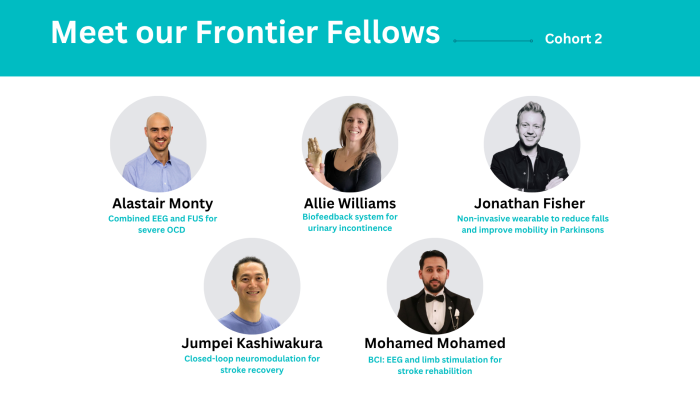
Louise is based at the BRC in Cambridge, one of the consortium’s nine partner organisations, responsible for leading the Fellowship, providing commercialisation training for Frontier Fellows and providing a host institution for several Cambridge NeuroWorks fellows, and she is careful to credit that wider network for making the programme possible. She frames Cambridge NeuroWorks’ real achievement as what happens when BRC’s life-sciences expertise is combined with the university’s research centres, the NHS trust’s patient access and the other partners’ networks. When the work is extended out to individuals across the country it has, she says, “catalysed some really new opportunities and new communities that we wouldn’t have had on our own within Cambridge alone.” That value, while hard to quantify in isolation, becomes clearer, she argues, with every fellow who succeeds.
A test case for a wider argument
What Cambridge NeuroWorks is really testing, beneath the talk of fellowships and consortium partners, is whether the UK’s perennial complaint about its own science base — world-class research, weak commercialisation, promising companies sold or relocated before they scale — can be addressed by structure rather than simply by more money.
Neurotechnology, with its long development timelines, high failure rates and unusually fragmented base of academic, clinical and commercial expertise, is in some ways the hardest possible field in which to prove that argument. If a wraparound support model can meaningfully cut years off the journey from lab bench to patient here, in a sector defined by its difficulty, the case for applying the same blueprint elsewhere in UK life sciences becomes considerably harder to dismiss.
For now, the evidence rests on one cohort of fellows and their own testimony about the years they believe they have saved. Whether that holds up as the programme scales — and whether investors keep showing up in the numbers Louise is asking for — will determine if Cambridge NeuroWorks becomes the national blueprint she describes, or one more well-intentioned pilot in a field that has seen no shortage of them.
This article is based on an interview conducted for Cambridge NeuroWorks.